Publikationen

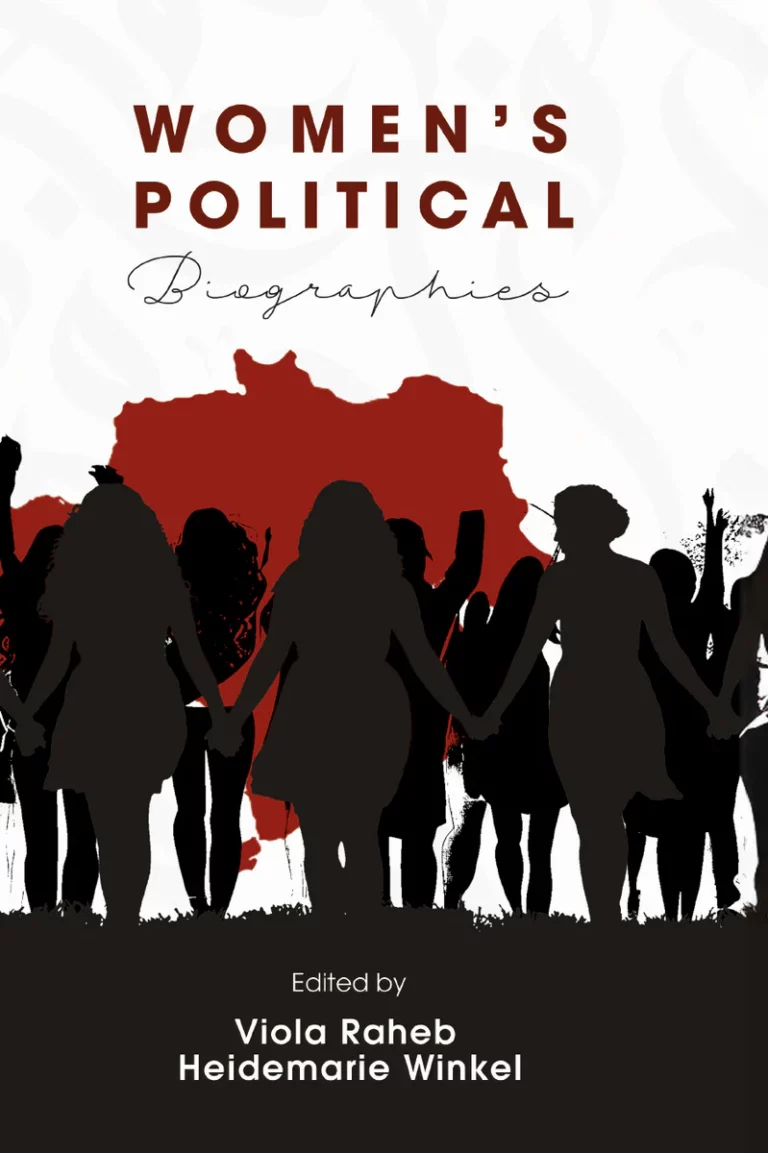
Viola Raheb and Heidemarie Winkel (editors): WOMEN`S POLITICAL BIOGRAPHIES IN THE MENAT REGION
Publikation
Published in Autumn 2023

Viola Raheb and Heidemarie Winkel (editors): WOMEN`S POLITICAL BIOGRAPHIES IN THE MENAT REGION

At the end of the conference at the Bruno Kreisky Forum in November 2023 on „Women’s lives and agency in the MENAT Region- between political activism and realism“, women from different countries and backgrounds were invited to shed light on their contexts, socio-economic and political developments, violence – especially gender-based violence – in times of war and its impact on women’s lives, engagement and agency. With the rise of populism and reactionary movements, women’s rights seem to need to be renegotiated. As a result of polarization and ambivalence, listening to and understanding women from the MENAT region is becoming less important.
In many Western countries, a hegemonic perception of the lives and work of women in the MENAT region prevails and a knowledge deficit compared to other regions of the world, e.g. Latin America, still exists. The book aims to give female political actors from the region a face and a name by using biographical essays as a method of knowledge production and awareness-raising, while promoting synergies and advocating the need for networking and cooperation.

„Eleven biographies from seven different countries from diverse generations, backgrounds, and areas of engagement are presented in this book. In their biographies, the contributors address political developments over the last decades in their countries and the region. Historical political phases, be it the end of the colonial rule and the phase of independence in Tunisia, the Baath-rule era and the war in Syria, or the Palestinian Nakba of 1948 and the continuing wars and displacement of Palestinians, become embodied in the lives of the women narrators and how these phases shaped and still shape their lives and work.” Viola Raheb, Co-Editor

ARMBRUSTERGASSE 15
Beilage
22. September 2021

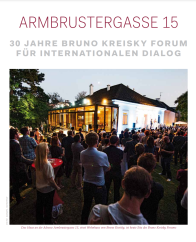
ARMBRUSTERGASSE 15

Anlässlich des 30. Geburtstages des Bruno Kreisky Forums für internationalen Dialog erschien am 22. September 2021 im FALTER  die Beilage ARMBRUSTERGASSE 15.

Unser Gründungs- und Ehrenpräsident Franz Vranitzky erzählt darin die Geschichte des Forums, der Historiker Oliver Rathkolb, Mitbegründer und Mitglied des wissenschaftlichen Beirates des Kreisky Forums, erzählt die Geschichte des Hauses. Der große Philosoph Franz Schuh würdigt den Menschen und Staatsmann Bruno Kreisky. Und eine fotografische Rückschau wirf einen Blick auf die vielen großartigen Veranstaltungen und Vortragenden der letzten 30 Jahre.

Gerne können Sie die Broschüre bei uns anfordern. Schicken Sie uns doch ein Mail: kreiskyforum@kreisky-forum.org!

Und jetzt: Viel Freude beim Blättern.

The Arab and Jewish Questions
Buchempfehlung
Dezember 2020

The Arab and Jewish Questions

Geographies of Engagement in Palestine and Beyond

Edited by Bashir Bashir and Leila Farsakh
Columbia University Press
Nineteenth-century Europe turned the political status of its Jewish communities into the “Jewish Question,” as both Christianity and rising forms of nationalism viewed Jews as the ultimate other. With the onset of Zionism, this “question” migrated to Palestine and intensified under British colonial rule and in the aftermath of the Holocaust. Zionism’s attempt to solve the “Jewish Question” created what came to be known as the “Arab Question,” which concerned the presence and rights of the Arab population in Palestine. For the most part, however, Jewish settlers denied or dismissed the question they created, to the detriment of both Arabs and Jews in Palestine and elsewhere.

This book brings together leading scholars to consider how these two questions are entangled historically and in the present day. It offers critical analyses of Arab engagements with the question of Jewish rights alongside Zionist and non-Zionist Jewish considerations of Palestinian identity and political rights. Together, the essays show that the Arab and Jewish questions, and the Israeli-Palestinian conflict in which they have become subsumed, belong to the same thorny history. Despite their major differences, the historical Jewish and Arab questions are about the political rights of oppressed groups and their inclusion within exclusionary political communities—a question that continues to foment tensions in the Middle East, Europe, and the United States. Shedding new light on the intricate relationships among Orientalism, anti-Semitism, Islamophobia, colonialism, and the impasse in the Israeli-Palestinian conflict, this book reveals the inseparability of Arab and Jewish struggles for self-determination and political equality.

Contributors include Gil Anidjar, Brian Klug, Amal Ghazal, Ella Shohat, Hakem Al-Rustom, Hillel Cohen, Yuval Evri, Derek Penslar, Jacqueline Rose, Moshe Behar, Maram Masarwi, and the editors, Bashir Bashir and Leila Farsakh.

About the Author
Bashir Bashir is associate professor in the Department of Sociology, Political Science, and Communication at the Open University of Israel and a senior research fellow at the Van Leer Jerusalem Institute. He is coeditor of The Politics of Reconciliation in Multicultural Societies (2008) and The Holocaust and the Nakba: A New Grammar of Trauma and History (Columbia, 2018).

Leila Farsakh is associate professor and chair of the Department of Political Science at the University of Massachusetts Boston. Her books include Palestinian Labour Migration to Israel: Labour, Land, and Occupation, second edition (2012).

Pub Date: December 2020
ISBN: 9780231199216
320 Pages
Format: Paperback
List Price: $35.00£27.00
Palestine 2030 – A decade of Clarity and Renewal
Report
30. Juni 2020

Palestine 2030 – A decade of Clarity and Renewal

Mapping the Transformations in the Three Spheres of Influence: Israel, the Region, and the International
published by Palestine Strategy Group

The Palestine Strategy Group (PSG), partner of the Bruno Kreisky Forum for International Dialogue, convenes meetings, focus groups, develops strategic analysis, scenario planning and provides space for debate on policy and ways forward. PSG has been busy working towards the publication of the ‘Palestine 2030 – A decade of Clarity and Renewal’ report launch.

‘Palestine 2030’ builds on twelve specially commissioned research papers and several in person workshops that analyse the Palestinian issue through the lens of the changing Israeli, regional and international contexts. The report provides up-to-date insights into the contemporary realities of the Palestinian struggle for freedom within this changing environment and offers options, scenarios and pathways towards rejuvenating Palestinian morale and a peaceful settlement of the conflict.

The report is a collective output, enriched by feedback received by round-table participants throughout the drafting process, including Palestinian academic, political and civil society leaders from the West Bank and Gaza, Israel, as well as from the Refugee and Diaspora Communities.

The report was launched on 30 June 2020.

The Holocaust and the Nakba
Buchempfehlung
November 2018

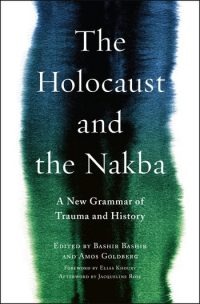
The Holocaust and the Nakba

A New Grammar of Trauma and History
Edited by Bashir Bashir and Amos Goldberg.
Foreword by Elias Khoury. Afterword by Jacqueline Rose.

In this groundbreaking book, leading Arab and Jewish intellectuals examine how and why the Holocaust and the Nakba are interlinked without blurring fundamental differences between them. While these two foundational tragedies are often discussed separately and in abstraction from the constitutive historical global contexts of nationalism and colonialism, The Holocaust and the Nakba explores the historical, political, and cultural intersections between them. The majority of the contributors argue that these intersections are embedded in cultural imaginations, colonial and asymmetrical power relations, realities, and structures. Focusing on them paves the way for a new political, historical, and moral grammar that enables a joint Arab-Jewish dwelling and supports historical reconciliation in Israel/Palestine.

This book does not seek to draw a parallel or comparison between the Holocaust and Nakba or to merely inaugurate a “dialogue” between them. Instead, it searches for a new historical and political grammar for relating and narrating their complicated intersections. The book features prominent international contributors, including a foreword by Lebanese novelist Elias Khoury on the centrality of the Holocaust and Nakba in the essential struggle of humanity against racism, and an afterword by literary scholar Jacqueline Rose on the challenges and contributions of the linkage between the Holocaust and Nakba for power to shift and a world of justice and equality to be created between the two peoples. The Holocaust and the Nakba is the first extended and collective scholarly treatment in English of these two constitutive traumas together.

Columbia University Press
November 2018
ISBN: 9780231182973

DO i BELONG?
Buchempfehlung
May 2017

DO i BELONG?

REFLECTIONS FROM EUROPE

Edited by Anthony Lerman

‘Belonging’ is both a fundamental human emotion and a political project that affects millions. Since its foundation in 1957, the European Union has encouraged people across its member states to feel a sense of belonging to one united community, with mixed results. Today, faced with the fracturing impacts of the migration crisis, the threat of terrorism and rising tensions within countries, governments within and outside the EU seek to impose a different kind of belonging on their populations through policies of exclusion and bordering.
In this collection of original essays, a diverse group of novelists, journalists and academics reflect on their own individual senses of European belonging. In creative and disarming ways, they confront the challenges of nationalism, populism, racism and fundamentalism.
Do I Belong? offers fascinating insights into such questions as: Why fear growing diversity? Is there a European identity? Who determines who belongs? Is a single sense of ‘good’ belonging in Europe dangerous? This collection provides a unique commentary on an insufficiently understood but defining phenomenon of our age.
Authors include: Zia Haider Rahman, Goran Rosenberg, Isolde Charim, Hanno Loewy, Diana Pinto, Nira Yuval-Davis and Doron Rabinovici among others.

Pluto Press London
May 2017
ISBN: 9780745399959

EQUAL RIGHTS FOR ALL: A NEW PATH FOR ISRAEL-PALESTINE?Equal rigts for all: a new path for Israel-Palestine?
Publikation
March 2015

EQUAL RIGHTS FOR ALL: A NEW PATH FOR ISRAEL-PALESTINE?Equal rigts for all: a new path for Israel-Palestine?

A Two-Day International Conference Birkbeck, University of London

Independent Jewish Voices in collaboration with the
Bruno Kreisky Forum for International Dialogue

Conference aims:

  • To help shift the debate from externally imposed or brokered state-centric solutions to the building of a new campaign in Palestine-Israel and internationally to achieve full civil and political rights.
  • To provide a forum for like-minded Israeli Jews and Palestinians in Israel and the occupied territories, as well as their diasporic supporters, to engage in discussion of this new approach, with the participation of sympathetic politicians, policy-makers, think tank experts, activists and media.
  • To provide a new focus of activity for activists outside of Palestine-Israel, which would lead to building new and more powerful and united coalitions within the activist communities and especially among concerned groups and individuals in the Jewish and Palestinian diasporas.
Enhancing Women’s Share in Peace and Security
Symposium Report
Sepzember 2015

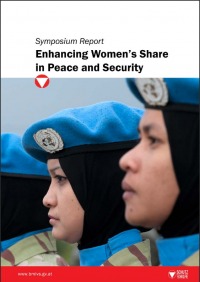
Enhancing Women’s Share in Peace and Security

Anlässlich des 15. Jahrestags der-Sicherheitsratsresolution 1325 (2000) der Vereinten Nationen und als Beitrag zur Peking +20 Kampagne von der Frauenorganisation der Vereinten Nationen “UN Women” fand vom 3. bis 4. November 2014 das Symposium “Enhancing Women’s Share in Peace and Security” in Wien statt. Die in diesem Symposium generierten Empfehlungen liegen nun in einer eigenen Publikation des Bundesministeriums für Landesverteidigung und Sport und dem Bruno Kreisky Forum für Internationalen Dialog vor.

Dokumenttyp:
Conference Papers
Herausgeber: Ursula Hann, Astrid Holzinger
Verlag: Bruno Kreisky Forum für Internationalen Dialog
ISBN: 978-3-9503890-1-2
Seiten: 132

Rethinking the Politics of Israel/Palestine.
Publikation
2014

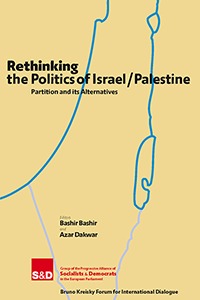
Rethinking the Politics of Israel/Palestine.

Partition and its Alternatives

Editors Bashir Bashir and Azar Dakwar
S&D Group in the European Parliamet/Bruno Kreisky Forum for international Dialogue
Vienna 2014
ISBN: 978-3-950-0-5

This volume, published by Bruno Kreisky Forum for International Dialogue and the S&D Group in the European Parliament, editetd by Bashir Bashir and Azar Dakwar, brings together the voices and views of leading Palestinian, Israeli Jewish and European intellectuals, politicians and activists, who prpose alternative approaches and “out of the box” thinking on the Israeli-Palestinian conflict. More specifically, this unique volume aims to contribute to the emerging efforts of re-examining the current strategies and paradigms through proposing and exploring new perspectives, visionary discourses and alternatives to partition in the case of the Israel-Palestinian conflict. Put differntly, it seeks to enrich European public discourse with original and refreshing views and alternative paradigms to settling this lingering conflict.

We present the volume as PDF Download. To order the free of charge coverversion please send an email to kreiskyforum@kreisky.org

Justice and Memory
Publikation
2009

Justice and Memory

Confronting traumatic pasts. An international comparison
Herausgegeben von Ruth Wodak, Gertraud Auer Borea d’Olmo
Reihe Passagen Gesellschaft, erschienen 2009

Every society must cope with traumatic pasts. The many ways in which societies cope with the past(s) form part of the „politics of the past“: history is thus continuously reformulated ex post facto and presented as a seemingly coherent narrative related to specific (hegemonic) interests.
The present volume summarises the contributions of 18 prominent scholars of an international interdisciplinary conference at the Bruno Kreisky Forum for International Dialogue, Vienna, in June 2008. Commemorative events, issues of guilt, justice and legitimation as well as forms of restitution were compared, analysed and discussed in respect to their functions, objectives and effects, while focussing their specifically national contexts of origin and their respective impact. Thus, the many dimensions of „remembering and forgetting“ were part and parcel of the theoretical and methodological presentations, on the one hand, and of specific national case studies (in Europe, South-Africa, South America (Chile), Israel, and so forth), on the other. Salient social phenomena such as war crimes and tribunals, the functions of ideologies and images of the past (Geschichtsbilder) were deconstructed and critically debated, always related to specific national and transnational contexts. It became obvious that the past(s) can never be silenced; and that they always impinge on the present and future of all societies – and our lives.

Genial dagegen – die Reihe
Reihe
laufend

Genial dagegen – die Reihe

Robert Misik
Gertraud Auer Borea

Die Finanzkrise hat seit langem anstehende Themen nachdrücklich in den Mittelpunkt gerückt. Brauchen wir neue Spielregeln in der Wirtschaft? Handelt es sich bei den momentanen Problemen um eminente Krisensymptome?
Nicht nur vor dem Hintergrund der globalen Finanz- und Wirtschaftskrise stellt sich die Frage, wie eine Welt aussehen kann, in der soziale Gerechtigkeit politisch wieder Bedeutung zugemessen wird.
Robert Misik, Autor des Bestsellers “Genial dagegen”, hat politische Aktivisten, Gesell-schaftskritiker und kritische Wissenschaftler eingeladen, originelle Gedanken gegen den politischen und ökonomischen Mainstream festzuhalten: Denn soziale Gerechtigkeit und wirtschaftliche Prosperität widersprechen sich nicht, auf lange Sicht ist das eine ohne das andere nicht zu haben. Aber wie kann ein neuer wohlfahrtsstaatlicher Kapitalismus aussehen? Was muss getan werden, um die globale Ökonomie stabiler zu machen? Wie kann mehr Demokratie in unsere Demokratie gebracht werden?
Mit Beiträgen u.a. von Robert Castel, Ève Chiapello, Colin Crouch, Heiner Flassbeck, James K. Galbraith, Eva Illouz, Katja Kipping, Jeremy Rifkin, Kurt W. Rothschild, Richard Sennett und Richard Wilkinson.

Lebensmodell Diaspora
Buchempfehlung
2014

Lebensmodell Diaspora

Über moderne Nomaden
Isolde Charim / Gertraud Auer Borea (Hg.)

Die Dynamik der globalen Ökonomie erzeugt eine zusehends grenzenlose Mobilität. Während die Standorte dem Sog der Flexibilisierung folgen können, sind die darin befangenen Menschen nach wie vor an fixe, ›geerdete‹ Identitätskonzepte gebunden. Unsere nationalstaatlichen Kulturen verfügen jedoch über keine mentalen Reserven für das Leben moderner Nomaden.
Dieses Buch – eine Art ›geistige Ölbohrung‹ – begibt sich auf die Suche nach solch einer Ressource. Die Beiträge gehen dabei vom Konzept der Diaspora aus – nicht als Synonym für Leid und Vertreibung, sondern als reicher Erfahrungsschatz.
Globales Denken am Puls der Zeit.
Mit Beiträgen u.a. von Benedict Anderson, Zygmunt Bauman, Homi K. Bhabha, Tony Judt und Gayatri C. Spivak.

Thema: Warum Krieg?
Sammlung
2014

Thema: Warum Krieg?

Texte und Protokolle zum Briefwechsel Albert Einstein / Sigmund Freud, Warum Krieg? 1933
Cathrin Pichler
Ein Programm des Bruno Kreisky Forums für internationalen Dialog.

Mit Beiträgen von Stephen Barber, Slavenka Drakulić, Raghavendra Gadagkar, Jochen Gerz, Mark Gisbourne, Gerhard Grössing, Moritz Leuenberger, Robert Jay Lifton, Sylvère Lotringer, Helga Nowotny, Anton Pelinka, Wolfgang Petritsch, Cathrin Pichler, Doron Rabinovici, Horst-Eberhard Richter, Yehuda E. Safran, Jean-Jacques Salomon, M. S. Swaminathan, Joseph Weizenbaum
Die beiden Briefe, die Albert Einstein und Sigmund Freud 1932 wechselten und die 1933 vom “Institut für Intellektuelle Zusammenarbeit des Völkerbundes” veröffentlicht wurden, bezeichnete Freud als “eines der letzten Signale der europäisch-jüdischen Kulturweltbürger”. Die vom Wiener Bruno Kreisky Forum für internationalen Dialog eingeladenen Autoren reflektieren die Positionen in der heutigen Debatte um die Disposition zum Krieg, die Perspektiven des Pazifismus und die Versuche, die Traumen der vergangenen und gegenwärtigen Kriege zu bearbeiten.