„THE WILD HILDE“
YouTube premiere "From Kreisky's living room"
WOLFGANG MADERTHANER IN CONVERSATION WITH HILDE HAWLICEK
„THE WILD HILDE“
For the 80th birthday
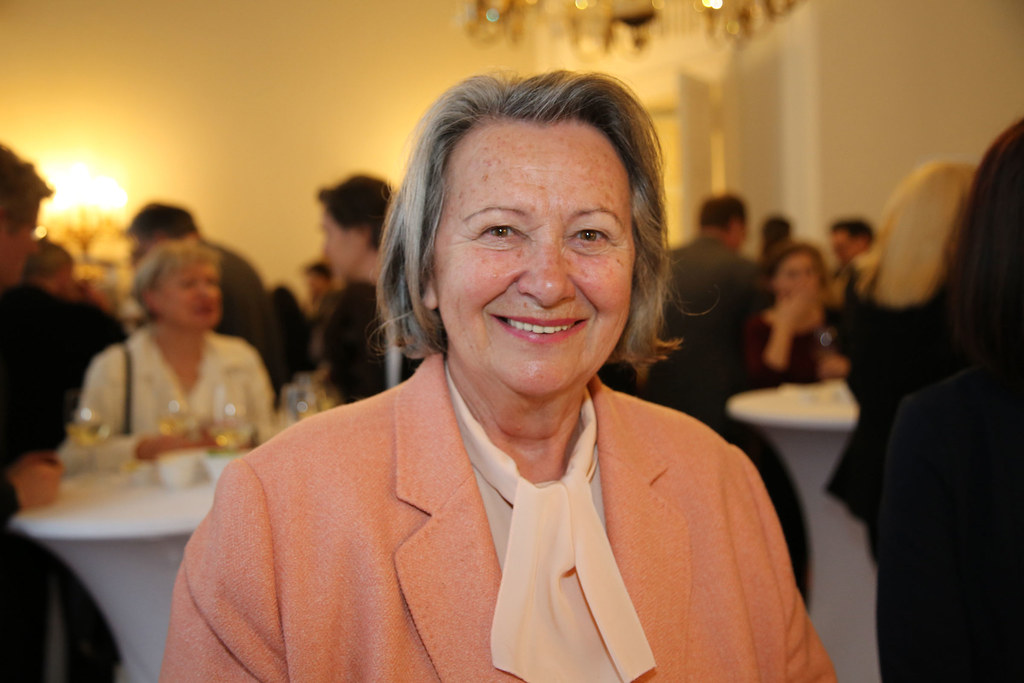
HILDE HAWLICEK was born on 14 April 1942 to a working-class family in Vienna. After graduating from high school in 1960, she studied to become a teacher of German and history at the University of Vienna and worked as a teacher at a general secondary school from 1968 to 1971.
As a teenager, her political commitment led her to join the Association of Socialist Secondary School Students, where she met Heinz Fischer and Karl Blecha, among others. She was later active in the Association of Austrian Socialist Students and the Socialist Youth. From 1965 to 1968, she was First Secretary of the Austrian Federal Youth Council.
In 1970 Hilde Hawlicek became a member of the SPÖ Federal Women's Committee, in October 1971 she was elected to the Federal Council and in 1976 to the National Council, where she was a member until 1987 and then again from 1990 to 1995. From 1987 to 1990, she was Minister for Education, the Arts and Sport.
Hawlicek, who loved to boogie-woogie and was called "Wild Hilde" by her comrades, drafted a law for all-day schooling, the Minority School Act for bilingual primary schools in Carinthia and implemented elective subjects, political education, environmental education and sex education with the sex kit. School experiments were to become the norm, girls were admitted to all types of school, "handicrafts" were replaced by the option of "textiles or technical work".
She also left a clear mark on culture. Hilde Hawlicek not only appointed Eberhard Waechter and Ioan Holender as the management duo of the State Opera, but also defended Claus Peymann's production of Thomas Bernhard's „Heldenplatz“ and extended the contract of the controversial Burgtheater director. In 1991, she appointed Gerard Mortier as artistic director of the Salzburg Festival, who, as Karajan's successor, opened up the festival to the less well-heeled and radically revitalised it. And by transforming the Bregenz Festival into a limited company, she made it possible for it to have a three-year budget.
During her time in office, Hawlicek, together with Finance Minister Ferdinand Lacina, passed the Arts Promotion Act with a separate budget for decentralised cultural initiatives; the vision was "culture for all“. The Vienna House of Literature was also founded under her aegis.
Hilde Hawlicek always remained committed to the European idea. From 1979 to 1995, she was a member of the Austrian delegation to the Parliamentary Assembly of the Council of Europe, with a brief interruption. From 1995 to 1999, she was head of the SPÖ delegation to the European Parliament, where she became deputy chair of the Committee on Culture, Youth, Education and the Media, among other things.
In 1999, she took on the role of Vice President of the Austrian Pensioners" Organisation under Karl Blecha. This was followed in 2001 by the founding of the European Seniors" Organisation (ESO) with Blecha as President and Hawlicek as Secretary General. In 2015, she became Vice President of the EU platform "AGE".
Moderation Wolfgang Maderthaner, Historian, Association for the History of the Labour Movement