Vienna in the post-war period
AUS KREISKY WOHNZIMMER online
IT IS A GOOD COUNTRY. Curated by Wolfgang Maderthaner
VIENNA IN THE POST-WAR PERIOD
A conversation with contemporary witnesses
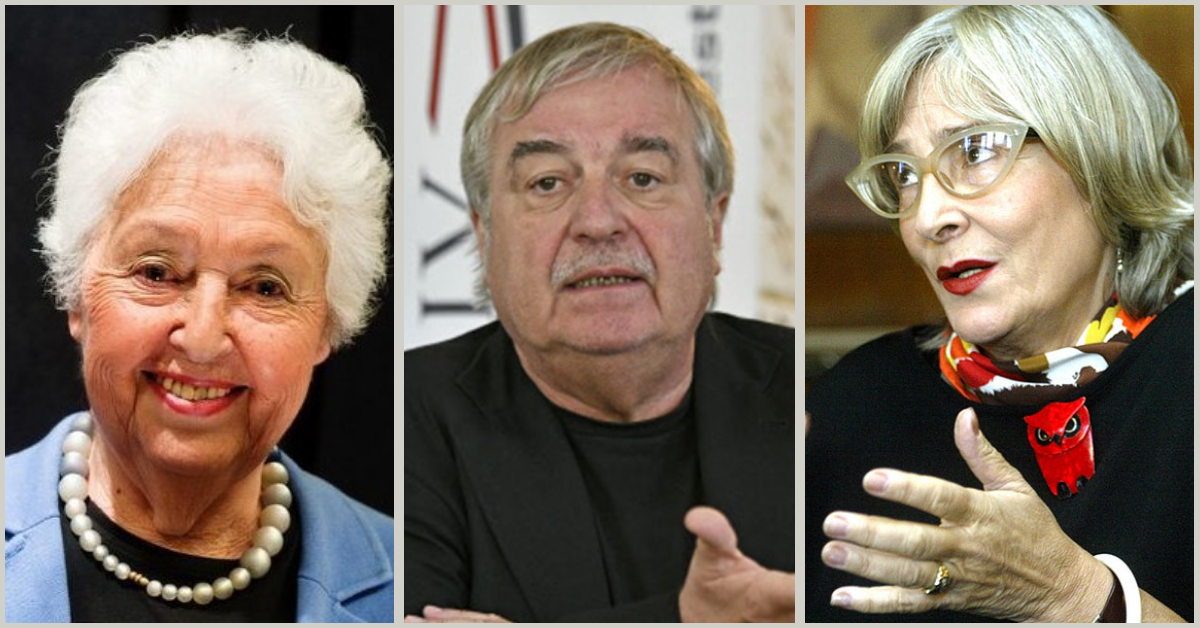
Barbara Coudenhove-Kalergi, Journalist and publisher
Emmy Werner, actress, theatre director and stage director
Moderation
Wolfgang Maderthaner, Historian, Association for the History of the Labour Movement
On 13 April 1945, a salute is fired from 324 cannons in Moscow as a sign that the Red Army has liberated Vienna - a city that has been badly scarred by the war. More than 20 per cent of the housing stock is completely or partially destroyed. Almost 87,000 flats are uninhabitable. More than 3,000 bomb craters are counted in the city. Numerous bridges lie in ruins. Sewers, gas and water pipes have suffered severe damage. Long queues form in front of grocery shops to buy at least one small item.
In August 1945, the Western Allies arrive in Vienna, on 1 September the troops of the four occupying powers take over their zones and remain until the ratification of the Austrian State Treaty on 15 May 1955.
Barbara Coudenhove-Kalergi, born in 1932, and Emmy Werner, born in 1938, experienced these difficult years in Vienna. They talk to Wolfgang Maderthaner about their everyday lives in post-war Vienna. And about how this time shaped them.
Barbara Coudenhove-Kalergi spent her childhood as a German-speaking citizen of Czechoslovakia. Her family lived in a villa in Prague-Smíchov, an industrial and working-class neighbourhood. In 1939, when she was seven years old, the Wehrmacht marched into Prague.
Since she was expelled from her homeland as a German from Prague in 1945, she has mostly lived in Austria. She worked as a journalist for the daily newspapers Die Presse, Neues Österreich and, after its closure in 1967, for the Arbeiter-Zeitung (taken over by Bruno Kreisky), the Kurier and the news magazine profil. She became known to the wider public in the mid-1970s as a member of the ORF's Eastern European editorial team, which was promoted by Gerd Bacher, initially on radio and later on television. Her sensitive reports for Austrian Radio focussed on the countries that were still part of the so-called Eastern Bloc at the time, especially Poland and Czechoslovakia, where she was stationed for a time as an ORF correspondent.
After the fall of the communist dictatorships, she returned to her native country. From 1991 to 1995, she worked as an ORF correspondent in Prague. Today she writes as a freelance journalist, mainly for Czech and Austrian newspapers, and is the editor of several books with texts on the history and present of the countries of the former Eastern Bloc. She has been a member of the editorial board of Datum magazine since 2005.
Barbara Coudenhove-Kalergi is co-founder of the citizens„ initiative “Land der Menschen" and has received numerous awards. In 2019, she was honoured with the Bruno Kreisky Prize for the political book for her complete journalistic oeuvre.
Emmy Werner was born in Vienna and spent her childhood here. Her father was Hans Werner, a writer and author of well-known Viennese songs, and her mother (1905-2002) Emmy Werner was a dancer at the Vienna Volksoper from 1920 to 1924. Her maternal grandfather was the architect Eduard Prandl.
After graduating from high school in 1956, she began training as an actress from 1957 to 1959 and had engagements at the Theater der Jugend, the Theater in der Josefstadt and the Volkstheater. She could be seen on television and heard in radio plays. She performed at the Theater der Courage from 1963 to 1968 and from 1973 to 1976, after which she worked as a dramaturg and director for theatre, film and television and was independently responsible for designing feature documentaries and directing a TV film. From 1980 to 1981, she co-directed the Theatre of Courage together with Stella Kadmon. In 1979/1980 she initiated the founding of the small theatre Theater in der Drachengasse, which opened in 1981 and where she took over the management and continued to direct and act until 1987.
On 1 January 1988, Emmy Werner joined the management of the Volkstheater Wien, which she led as artistic director from 1 September 1988 to 31 August 2005. During this time, she directed 13 plays.