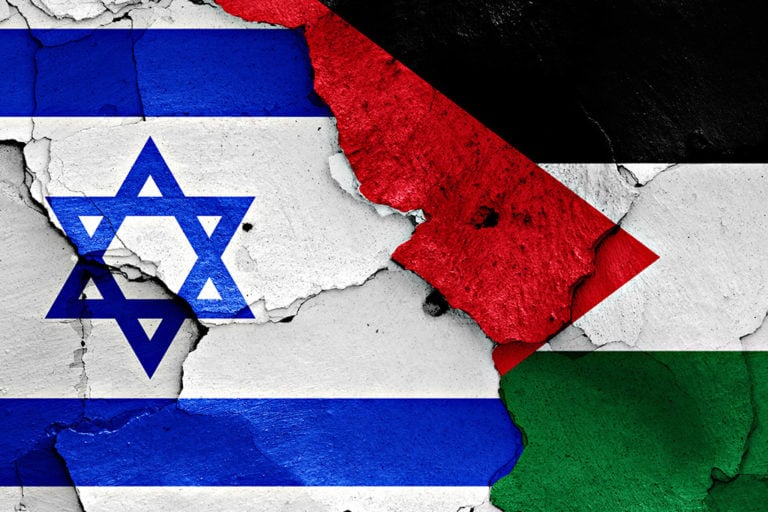
What are the prospects for Israeli-Palestinian relations in the wake of the Israeli elections?
Panel discussion as part of the wiiw-oiip seminar series 'Europe in a Fragmented World: Geo-economic and Geo-political Dynamics'
This panel will discuss three topics in the wake of the Israeli and US elections:
To what extent can civil society organisations shape Palestinian-Israeli relations, and how do they influence political processes?
Are there likely to be changes in the social and economic situation of the Palestinian population in Israel, and how does it engage politically?
What developments are likely in the occupied territories (the West Bank and Gaza)? Are there any possible scenarios for positive economic and social developments in these territories and for the reconstruction of Gaza?
Panellists
Anat Ofek, an active member of the New Israel Fund’s (NIF) Shatil Centre for Policy Change (CPC)
Aida Toumi-Suleiman, Israeli Arab journalist and politician
Sameh Hallaq, Affiliated Researcher at the Palestine Economic Policy Research Institute (MAS)
Moderation
Michael Landesmann, wiiw
Following the discussion with the three panellists, there will also be brief contributions from Dr Cengiz Gunay (Director, oiip) and Mag. Sabine Kroissenbrunner (Secretary General, BKF) on the changing regional context in Israel/Palestine.
Anat Ofek is an active member of the New Israel Fund’s (NIF) Shatil Centre for Policy Change (CPC). She manages the lobbying activities of the coalition of civil society organisations supported by NIF Shatil in the Knesset. The New Israel Fund funds activists and organisations that defend human rights, combat far-right extremism, and promote the causes of peace, equality and democracy. The Shatil Centre for Policy Change acts as a central hub for Israeli non-governmental organisations (NGOs), activists and progressive civil society groups seeking to influence public policy and government decision-making.
Aida Toumi-Suleiman is an Israeli Arab journalist and politician. She has been a member of the Israeli Parliament (Knesset) for Hadash (part of the Joint List) since 2015. She is the fourth Arab-Israeli woman to become a member of the Knesset and the second Arab-Israeli woman to be elected to the Knesset from a non-Zionist party. She was elected (by a unanimous vote) to chair the Knesset’s Committee on the Status of Women and Gender Equality. She was the first female member of the High Follow-Up Committee for Arab Citizens of Israel and co-founded the International Women’s Commission for a Just Palestinian–Israeli Peace.
Sameh Hallaq is an affiliated researcher at the Palestine Economic Policy Research Institute (MAS), an Associate Professor of Economics at Al-Quds Bard College, Al-Quds University, and a Research Affiliate at the Levy Economics Institute of Bard College, New York, USA. He was awarded his PhD in Economics from the University of Wuppertal, Germany, in 2019. His research focuses on human capital in Palestine, particularly the factors shaping early-life outcomes in education, health and well-being amidst political and economic instability and prolonged violent conflict. His work also examines the long-term implications of these early-life conditions for educational attainment and labour market outcomes, including employment, wages and working conditions.
This discussion will be organised jointly by NIF (the New Israel Fund) which supports civil society organisations in Israel/Palestine, the Vienna Institute for International Economic Studies (wiiw), the Austrian Institute for International Affairs (oiip) and the Bruno Kreisky Forum for International Dialogue (BKF).
*The seminar series, entitled Europe in a Fragmented World: Geo-economic and Geo-political Dynamics, jointly organised by the Vienna Institute for International Economic Studies (wiiw) and the Austrian Institute for International Affairs (oiip), aims to analyse geopolitical and geoeconomic trends and their impact on Europe’s future from an interdisciplinary perspective. The series seeks to contribute to the ongoing debates on how to reposition Europe within an increasingly politically unstable and economically competitive international system.