WHAT AUTOCRATS FEAR
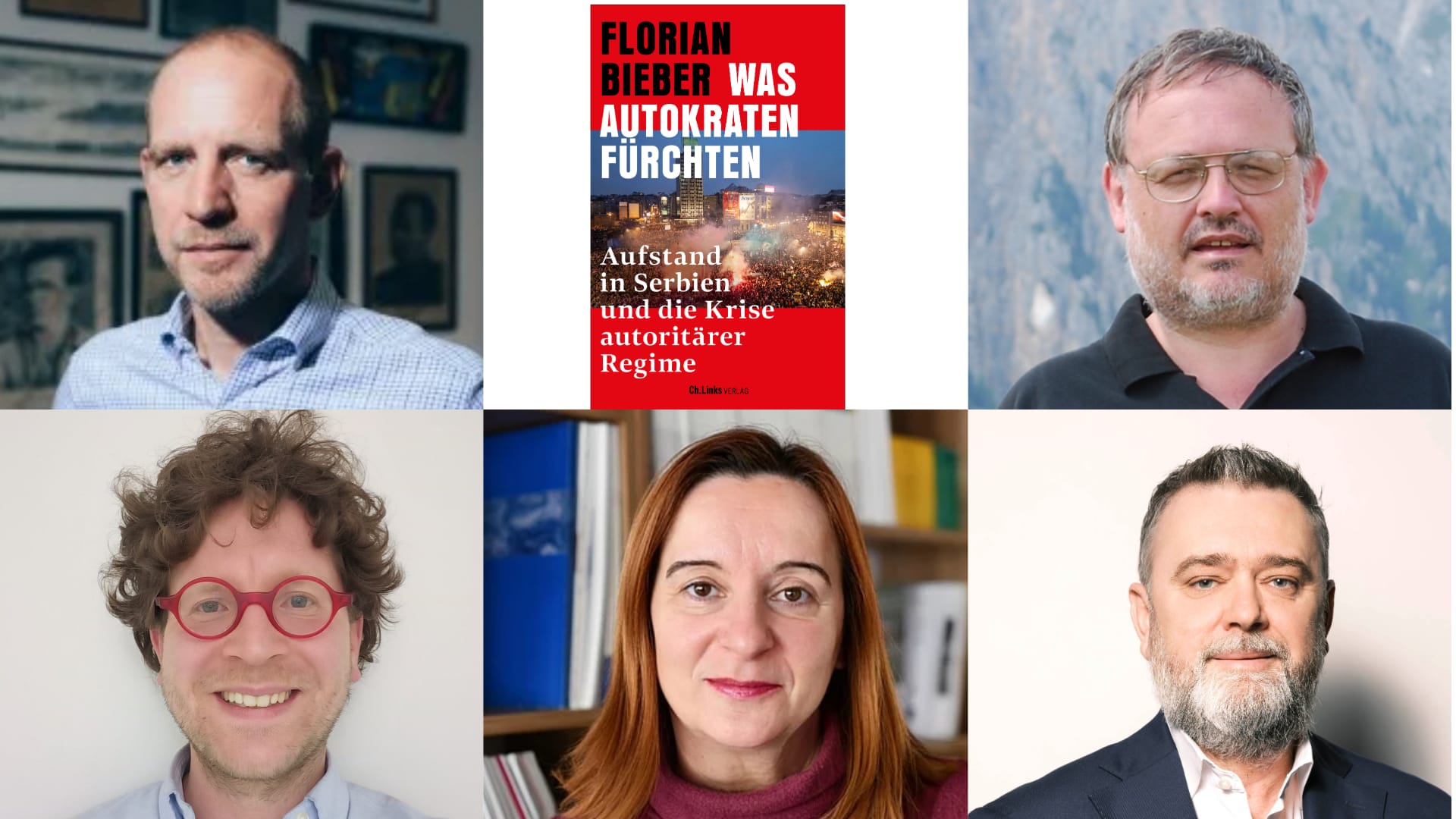
Serbia – a key country in a state of upheaval: For a long time, the majority of the Serbian population was considered politically apathetic. Protests that flared up sporadically came to nothing. When the canopy at Novi Sad railway station collapsed in November 2024, killing several people, that changed abruptly. A broad protest movement emerged across the country: people are demanding a full investigation, denouncing abuses within the government and the civil service, and calling for the rule of law, public scrutiny and a genuine crackdown on corruption. Since then, President Vučić has come under increasing pressure.
Using this powerful movement as an example, Balkan expert Florian Bieber highlights the significance of civil protests – for Serbia, but also for Europe, Russia and the US. This is because, across the globe, autocrats such as Vučić, Orbán, Putin and Trump fear civil society protests – and combat them using the same tactics time and time again.
However, our focus should not be limited to Serbia. Other countries in the region also demonstrate how civil society protests can challenge established political power structures. In Hungary, the parliamentary elections in April 2026 brought an end to the 16-year reign of Viktor Orbán and his Fidesz party. In Albania, meanwhile, the protests of the so-called „Flamingo Revolution“ have been ongoing for months. Triggered by a controversial luxury development on the Adriatic coast – in which Donald Trump’s son-in-law, Jared Kushner, is also involved – the protests are now increasingly directed against corruption, a lack of transparency and Edi Rama’s government.
Taking Serbia as a starting point and looking at Hungary, Albania and other countries in the region, the discussion will focus on the conditions under which civil society movements can challenge authoritarian and illiberal structures. What strategies do governments use to curb protest? When do protest movements succeed in bringing about political change beyond short-term mobilisation? And what prospects does this open up for democracy and the rule of law in the respective countries?
Florian Bieber, is a professor of South-Eastern European history and politics at the Centre for South-Eastern European Studies at the University of Graz. He coordinates the Balkans in Europe Policy Advisory Group (BiEPAG). His most recent publications include *Debating Nationalism* (Bloomsbury 2026), *Hvar in the Modern Age. Identity and Change in South-East Europe* (Bloomsbury 2026), and *What Autocrats Fear: Uprising in Serbia and the Crisis of Authoritarian Regimes* (Ch. Links 2026).
Peter Techet, who holds a PhD in law and history, is a research fellow at the Institute for the Danube Region and Central Europe (IDM) and a postdoctoral researcher at the Faculty of Law, University of Zurich.
Noljan Lole, journalist, editor-in-chief of the Albanian public broadcaster RTSH.
Tanja Topić, correspondent and member of the editorial team at the Belgrade weekly newspaper Vreme and a research fellow at the Friedrich Ebert Foundation in Banja Luka. She studied political science.
Moderation
Gregor Mayer, lives in Belgrade and Budapest as an author and journalist. He studied philosophy and mathematics at the University of Graz.
Registration:
"*" indicates required fields