Bridging Beliefs in Vienna: Religious Communities as Partners in Democratic Life
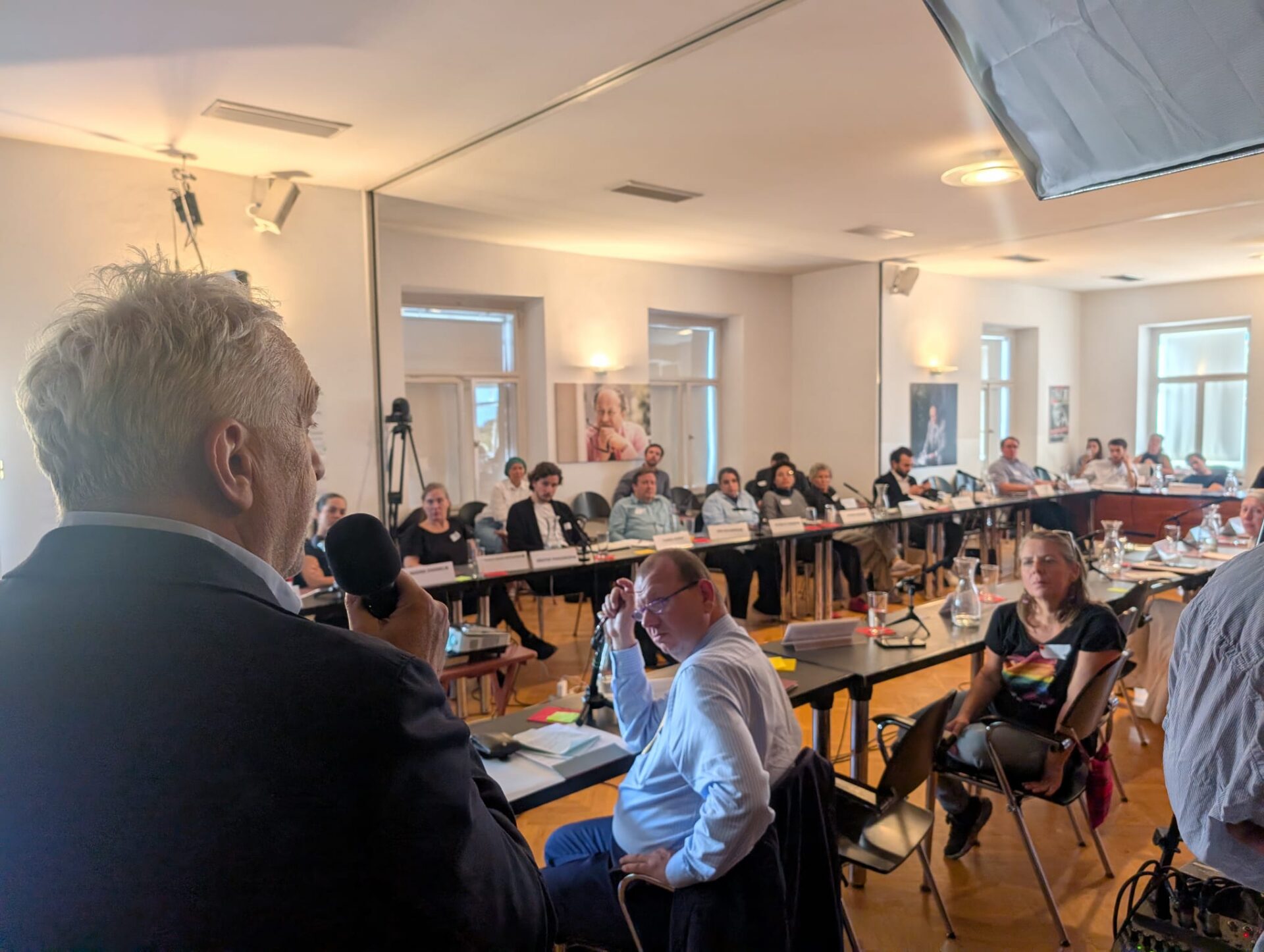
On 15 September, the Muslim Jewish Leadership Council (MJLC), in collaboration with the Bruno Kreisky Forum for International Dialogue, which hosted the event in Vienna, brought together over 50 participants from public institutions, religious communities, schools and universities, youth organisations, and civil society for the Vienna Local Workshop of ‘Bridging Beliefs’: Advancing Peace, Democracy and Inclusion through Interfaith Dialogue in Europe.
The day began with two questions: How can interfaith dialogue strengthen democratic societies? And what is needed to turn individual encounters into lasting cooperation?
These were questions that struck a chord with the Kreisky Forum. The opening session revisited ideas closely associated with Bruno Kreisky and with the Forum’s work today: building bridges across differences, democracy, freedom and equality, and the importance of institutions working together if dialogue is to lead to action.
The workshop also began with a premise that is often overlooked in public discussions about religion. Religious communities are not merely constituencies whose needs public authorities must understand. They also possess knowledge, trusted relationships, leadership and communication networks that can serve as resources for the wider city. The question was therefore not only how institutions can respond to religious diversity, but what public institutions and communities can achieve when they know one another well enough to work together.
This made the Kreisky Forum a natural venue for such an exchange. The Forum operates at the intersection of political debate, diplomacy, civil society and public life, and has long provided a space for people with differing views to work through difficult issues without requiring those differences to disappear.
A wide range of institutions were represented. Among the participants were the City of Vienna Human Rights Office, MA17 Integration and Diversity, the Vienna State Parliament and City Council, and the Federal Ministry for European and International Affairs, alongside the Islamic Religious Authority in Austria (IGGÖ), Jewish community organisations, Jewish and Muslim youth organisations, the University of Vienna, schools, Caritas Vienna, churches, religious leaders, educators, and grassroots dialogue initiatives. Public policy, education, religious life and community practice were all woven into the discussions and recommendations.
The Vienna workshop built on the earlier Bridging Beliefs a capacity-building exchange in Vicenza, drawing on Vienna’s own experience. MA17 shared examples drawn from more than two decades of cooperation with religious and migrant communities. The projects varied, but the underlying lesson remained consistent: cooperation is built on relationships forged over time. Trust, regular contact and a thorough understanding of the communities involved are what make it possible to work together when more difficult issues arise.
Most of the day was spent in breakout working groups focusing on three areas: education and religious literacy; youth participation and sustainable interfaith engagement; and freedom of religion or belief, non-discrimination, and institutional cooperation. Participants began by asking what is already working well in Vienna, then where gaps remain, and finally what could realistically be improved. The groups were asked to move from identifying issues to formulating proposals grounded in local responsibilities, potential partners and practical first steps.
A clear picture emerged. Vienna has no shortage of good initiatives. Schools are creating spaces for people to come together. Religious communities and public institutions have built working relationships over many years. Youth and civil society organisations are bringing people together across religious and social divides. What is often lacking is continuity. Successful work can depend on a small number of committed individuals, unpaid labour, short funding cycles, or relationships that have to be rebuilt when staff change.
Participants discussed a format for interfaith dialogue, a more robust school-based exchange programme involving greater youth participation, and the possibility of establishing a more regular city-wide framework for interfaith cooperation. The topic of religious literacy also recurred throughout the day: public institutions need the knowledge and confidence to engage seriously with religious life, whilst religious communities need the ability to work effectively with public institutions and communicate beyond their own constituencies.
The closing discussion centred on what happens after an event such as this. Participants were clear that the work should not be put on hold until the next meeting, only to start again from scratch. The relationships and proposals developed during the workshop should be taken forward through smaller working groups, ongoing dialogue with stakeholders, and the next stages of Bridging Beliefs. Better coordination can in itself make a difference: sometimes the missing piece is not another project, but knowing what already exists and bringing the right people together.
The workshop also demonstrated why Vienna can be of significance beyond Austria. The city is home to established religious communities, public institutions with decades of experience in working with diversity, active schools and universities, and a strong network of civil society and youth organisations. Participants suggested that Vienna could show other European cities what sustained cooperation between public institutions and religious communities can look like in practice. The opportunity now is to link these strengths more deliberately and ensure that successful initiatives have sufficient continuity to be of benefit beyond the city itself.
About the project
Bridging Beliefs: Advancing Peace, Democracy and Inclusion through Interfaith Dialogue in Europe (Bridging Beliefs) is a European project that brings together local authorities, religious communities, civil society organisations and citizens across European cities. Through capacity-building, local workshops, consultations and dialogue events, the project works to strengthen democratic participation, inclusion and sustainable cooperation across religious and ideological differences.
The Muslim Jewish Leadership Council (MJLC) is one of the project partners and leads the project’s work on Muslim-Jewish dialogue. ALDA – the European Association for Local Democracy – coordinates the project.
Project: Bridging Beliefs: Promoting Peace, Democracy and Inclusion through Interfaith Dialogue in Europe
Project number: 101249742
Programmes: Citizens, Equality, Rights and Values (CERV)
Project period: 1 January 2026–31 December 2027
Project coordinator: ALDA – European Association for Local Democracy
Project contact: Sara Afendi, Project Manager, ALDA
Email: sara@aldaintranet.org
Project partners
ALDA – European Association for Local Democracy; European Buddhist Union; Equal Society; Local Democracy Agency Mostar; Regional Foundation for Local Development Zamah; Centre for Cultural Dialogue – CKD; Muslim Jewish Leadership Council; COREIS – Italian Islamic Religious Community; Municipality of Centar, Skopje; with the Academy for Interreligious Studies as an associated project participant. The Grant Agreement identifies ALDA as the coordinator and MJLC as one of the participating organisations.
Funded by the European Union.
Funded by the European Union. The views and opinions expressed are, however, those of the author(s) alone and do not necessarily reflect those of the European Union or CERV. Neither the European Union nor the funding body can be held responsible for them.
