HOW TO FIND COMMON GROUND FOR A DEMOCRATIC AND PROSPEROUS SYRIA
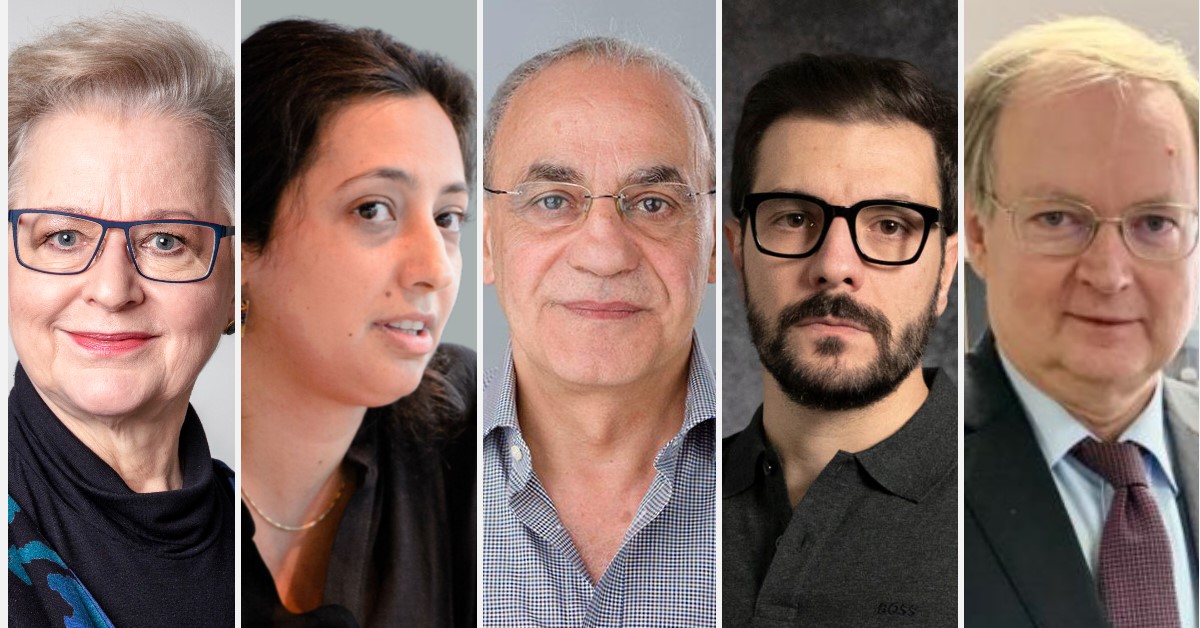
Gudrun Harrer in conversation with Maria Alabdeh, Aziz Al-Azmeh, Abdullah Al-Jabassini and Christian Berger
HOW TO FIND COMMON GROUND FOR A DEMOCRATIC AND PROSPEROUS SYRIA
The Assad family ruled Syria for more than five decades, starting with Hafez al-Assad in 1970 followed by his son Bashar al-Assad in 2000. Their rule was characterised by authoritarian control, oppression and conflict. In 2011, the Syrian civil war broke out after the regime violently suppressed pro-democracy protests. The war resulted in hundreds of thousands of deaths, the displacement of millions of people and the involvement of foreign powers, including Russia, Iran, Turkey and the USA. Bashar al-Assad was able to hold on to power with foreign support. However, Syria remained fragmented and large areas were controlled by Kurdish and rebel forces.
In December 2024, rebel forces led by Hay'at Tahrir al-Sham (HTS) of Ahmad al-Sharaa, nom de guerre Abu Mohammed al-Jolani, a former Al-Qaeda affiliate, captured Damascus. Bashar al-Assad fled to Russia. A provisional government was formed by Sharaa who later was appointed president by a military council. The new authorities promise vaguely a participatory process to draft a new constitution and hold elections in about four years.
Syria under Assad is still under international sanctions, however, also Sharaa and the HTS – which was dissolved in the meantime – are listed as terrorists. Nevertheless, the international community, and including Europe, has a profound interest in the stabilization of Syria and is ready to engage with the new regime. The panel will deal will the question how Syria can be helped to establish a stable political system and a positive future for its people, what role Europe and the surrounding region can play, and which challenges to expect regarding the influence of Islamist parties, particularly in relation to civil liberties and women's rights, and the treatment of religious minorities.
Maria Alabdeh is the Executive Director of Women Now for Development, an organization dedicated to empowering Syrian women and girls through education, protection, and political participation
Aziz Al-Azmeh, University Professor emeritus, Central European University; Co-Founding Director of SFM, Vienna. He is author of several books, among others Secularism in the Arab World, Islams and Modernities (German tr.: Die Islamisierung des Islam), Syria and the Fundamentalist Surge (in Arabic); and co-author of Striking from the Margins: State, Religion and Devolution of Authority in the Middle East, and Spoils of War in the Arab East: Reconditioning Society and Polity in Conflict. Forthcoming is Spoils of War and Gender Transformation in the Middle East and North Africa: Remodelling Society after 2011
Abdullah Al-Jabassini is a CIVICA Postdoctoral Research Fellow at Central European University in Vienna, an Adjunct Professor at Johns Hopkins University's School of Advanced International Studies in Bologna, and a Non-Resident Scholar at the Middle East Institute in Washington, D.C., specializing in political violence, civil war, and Middle Eastern studies.
Christian Berger, Austrian diplomat and former EU Ambassador to Egypt and Turkey, with extensive experience in Middle Eastern affairs and EU external relations
Gudrun Harrer, Leitende Redakteurin, Der Standard; Lektorin für Moderne Geschichte und Politik des Nahen und Mittleren Ostens an der Universität Wien und an der Diplomatischen Akademie Wien